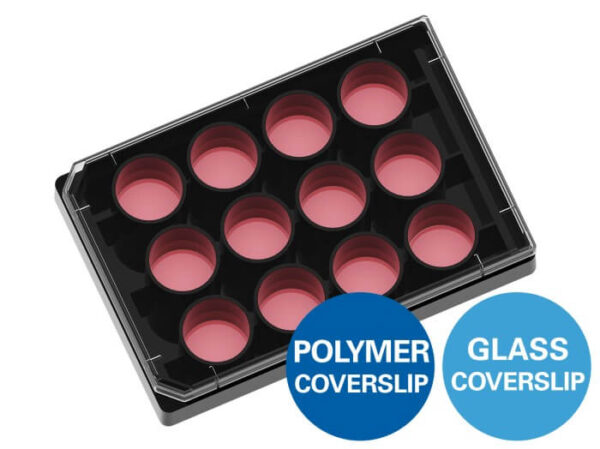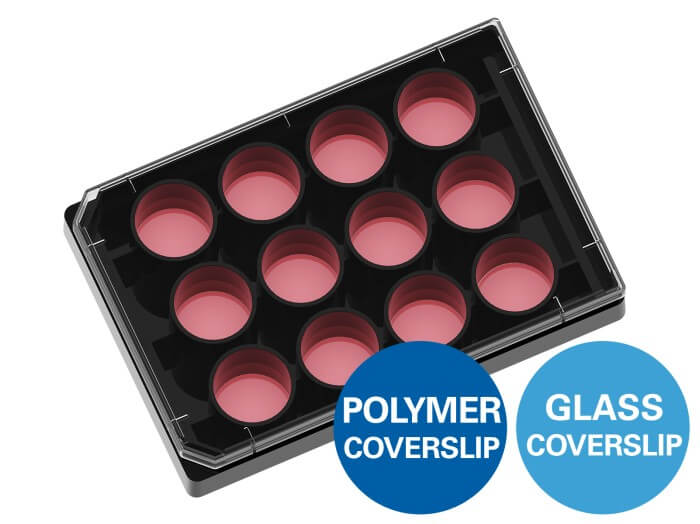
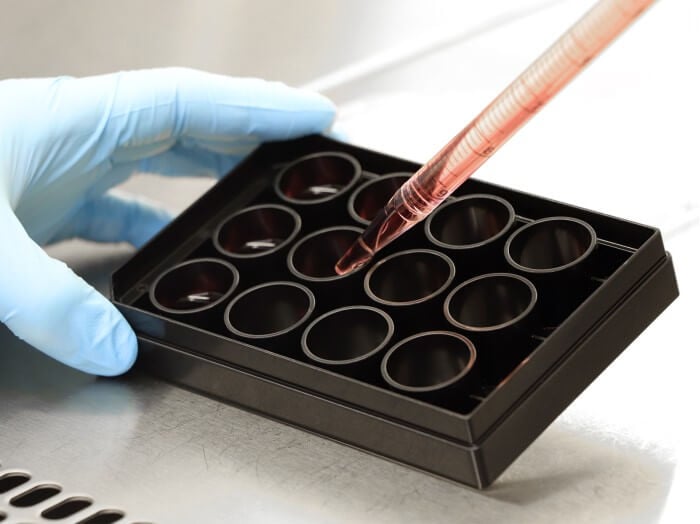
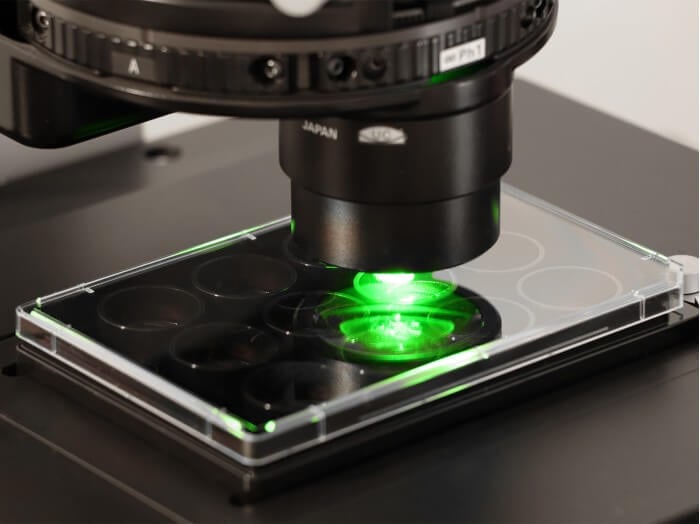

Black 12 well culture plate with a flat and clear bottom for cell culture and microscopy
Applications
Cell Cultivation and Imaging
- Cultivation and high-resolution microscopy of cells
- Parallel cell culture experiments with low cell and reagent volumes
- High-sensitivity immunofluorescence stainings and protein localization studies
- Live cell imaging and time-lapse studies over extended time periods
- Large-scale gene and protein expression analysis, transfection assays
- Drug discovery studies, cytotoxicity assays, and toxicology screenings with clear visibility of cell morphology
Microscopy Techniques
- Brightfield, phase contrast, and widefield fluorescence microscopy for cell monitoring on inverted microscopes
- Automated, multiparametric high-content screening (HCS) and high-throughput screening (HTS) with plate readers
- Super-resolution microscopy (STED, (F)PALM, (d)STORM, SIM) and TIRF (best output with #1.5H Glass Coverslip)
- Confocal microscopy, two-photon microscopy, FRAP, FRET, FLIM, and LSFM
Technical Features
Precision, Quality, and Biocompatibility
- µ-Plate (microtiter plate) in ANSI/SLAS (SBS) format
- Ready-to-use for lab automation and high-throughput with robotics, fluorescence scanners, and plate readers
- Twelve round wells with standard numbering (letters A–C and numbers 1–4)
- Excellent inner well flatness and whole plate flatness
- #1.5 ibidi Polymer Coverslip or #1.5H Glass Coverslip bottom with excellent optical quality
- No autofluorescence due to black walls
- Compatible with staining and fixation solutions
- Compatible with immersion oil
- Made from non-cytotoxic, biocompatible materials
- Sterile with single packaging
Product Versions
- With #1.5 ibidi Polymer Coverslip (different surfaces available) or #1.5H Glass Coverslip Bottom
How Does the µ-Plate 12 Well Work?
What Is the Principle of the µ-Plate 12 Well?
The µ-Plate 12 Well provides twelve independent wells on a thin, high-performance #1.5 ibidi Polymer Coverslip or #1.5H Glass Coverslip bottom. The flat, transparent imaging bottom delivers excellent optical quality and—together with the chosen surface—supports defined, reproducible cell adhesion. The ibiTreat (tissue culture-treated) surface has been designed for optimal cell adhesion on the #1.5 ibidi Polymer Coverslip bottom. This modification provides ideal growth conditions for nearly all types of adherent cells, eliminating the need for additional coatings.
What Is the µ-Plate 12 Well Used for?
With its standard microplate footprint, the µ-Plate 12 Well is suited for parallel cell culture and imaging workflows, such as immunofluorescence staining, brightfield and fluorescence microscopy, TIRF, and live cell imaging on inverted microscopes. Typical use cases include condition screens, dose–response experiments, and side-by-side controls in one plate.
Is the µ-Plate 12 Well Compatible With Automated Handling?
Yes. The microplate format fits common stage inserts and plate holders and is well suited for automated liquid handling, enabling reproducible, medium-throughput assays. It is ready-to-use for lab automation and high-throughput with robotics, fluorescence scanners, and plate readers.
Is the µ-Plate 12 Well Suitable for Live Cell Imaging?
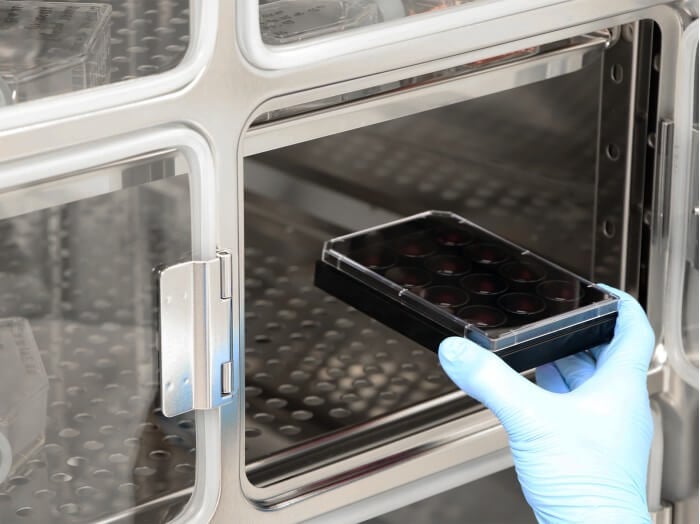
Yes. The coverslip-like bottom provides the optical performance required for long-term live cell imaging. For stable temperature, CO2, and humidity, use it together with a Stage Top Incubator.
How Do I Conduct Immunofluorescence Stainings With the µ-Plate 12 Well?
The µ-Plate 12 Well is well suited for immunofluorescence (IF) assays. Twelve separate wells enable multiple conditions and replicates in one plate, with convenient washing and staining directly in the wells. The integrated #1.5 or #1.5H imaging bottom provides excellent optics for widefield fluorescence and confocal microscopy—no additional coverslip mounting or sample transfer is required.